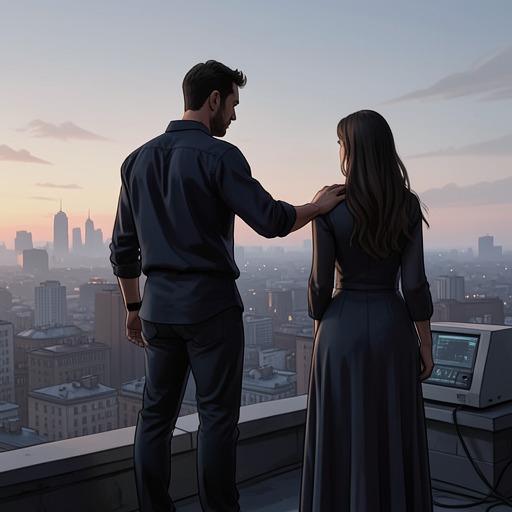
The Rooftop Kiss
Dark Lies the IslandThe Rooftop Kiss is a failed moment of intimacy in which physical closeness briefly seems mutual before the woman ends it with a light touch. The narrator’s account makes the rejection a decisive rupture: after she leaves, he remains on the rooftop as the summer, the crowd, and the music recede into memory.
The Kiss and Its Reversal
The narrator leans in before he can talk himself out of it and places his lips on hers. She responds, and their jaws move slowly, but the kiss does not become the romantic arrival he seems to hope for. Its reversal is communicated not through an argument or explicit explanation, but through the woman placing her fingertips lightly on his chest. That small pressure is enough to break the kiss.
The scene’s restraint gives the gesture its force. The contact lasts perhaps half a minute or a little longer, though the narrator cannot say exactly how long. He describes the touch as a pressure that tells him the encounter is already over; the physical limit becomes clearer than any spoken account of her feelings. The kiss therefore shifts from apparent reciprocity to unmistakable refusal without a dramatic confrontation.
Separation on the Rooftop
After the kiss ends, the woman turns quickly to look away, and the narrator turns in the opposite direction. The brief separation of their gazes extends the break in physical contact into an awkward shared silence. He describes his heart as taking in the morning’s black poison, making the rejection register as an emotional wound rather than a neutral end to an advance.
The scene remains set against ordinary summer details: the sun slants through a clouded sky, a church casts shade over Washington Street, and a pigeon’s heavy wingbeats interrupt the stillness. The woman places her palms on the ledge and stands, then says she is going to leave. These movements carry the encounter toward departure; neither a spoken explanation nor a reconciliation follows.
The Aftermath and Its Meaning
The narrator nods as coolly as he can, treating even this small composure as evidence of resilience. The woman crawls through the Velux window into the flat. He hears its door turn and click, then her footsteps on the stairs fading away. The sequence gives her departure a concrete end point while leaving the narrator alone with the rooftop and the city.
He describes sitting there for hours, months, and years, an impossible extension of the scene’s emotional duration. As the sun rises higher and warms the ledge and slates, the summer nonetheless seems to go with her. The crowd’s sound dies, the music ends, and people trail home along the sleeping streets; youth is packed away and life is about to begin. The kiss’s significance lies in this contrast between a moment that lasts only briefly and an aftermath the narrator experiences as vast, suspended time.